
Royal Rife's Frequency Medicine: Suppressed Science or Medical Revolution?
Health Harmonic Newsletter
Archives
Royal Rife's Frequency Medicine: Suppressed Science or Medical Revolution?
SIGN UP FOR OUR NEWSLETTER
Royal Rife's Frequency Medicine: Suppressed Science or Medical Revolution? |
In the 1930s, Royal Rife claimed to cure cancer with electromagnetic frequencies. Then he was erased from history. Now, the physics is being rediscovered—without his name. |
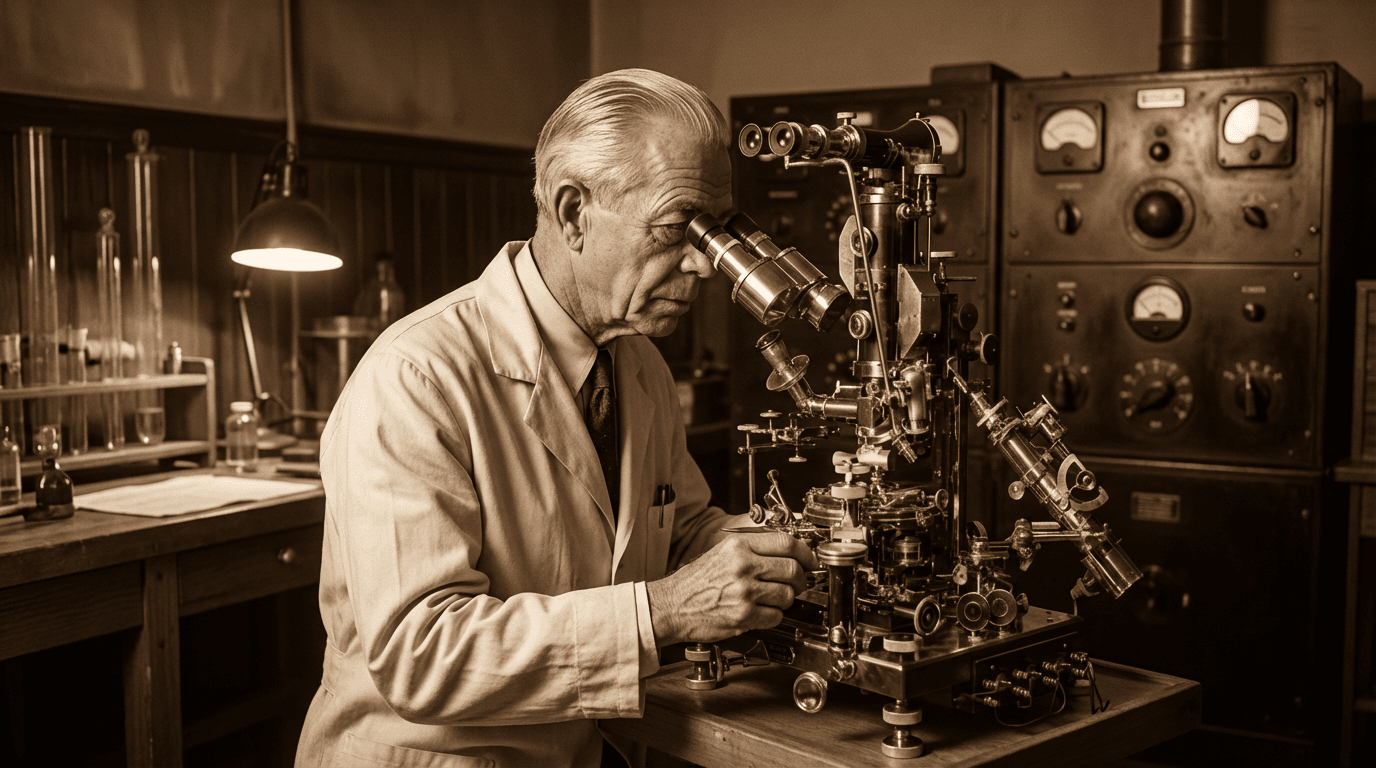 |
In the 1930s, Royal Raymond Rife (1888-1971) built a microscope so powerful it could observe living viruses without killing them. Using that technology, he claimed to destroy cancer cells and infectious agents using nothing but specific radiofrequency electromagnetic waves.
Then he was systematically erased from medical history.
For decades, Rife's work was dismissed as pseudoscience, his equipment destroyed, and his reputation buried under accusations of quackery. Anyone who mentioned his research risked professional exile.
But here is the thing: the physics behind frequency medicine has never been disproven. The principles Rife articulated are now being rediscovered, repackaged, and quietly reintegrated into mainstream research—just without his name attached.
What Rife Actually Discovered
Royal Rife was not a physician. He was an engineer, inventor, and optical pioneer. His Universal Microscope used a combination of 5,682 parts and prismatic refraction to achieve magnifications up to 60,000x with unprecedented resolution.
More importantly, it allowed him to observe living microorganisms in real time—something electron microscopes, which kill specimens with radiation, vacuum chambers and chemical dyes, cannot do.
Using this microscope, Rife observed that every microorganism had a specific resonant frequency signature. When exposed to that exact frequency along with a sharp spike on the waveform, the organism would vibrate, distort, and eventually rupture—a phenomenon he called the "mortal oscillatory rate."
Think of it like an opera singer shattering a wine glass. The glass has a resonant frequency. When sound waves match that frequency with sufficient amplitude, the glass vibrates until its structure fails.
Rife applied this principle to pathogens. And according to his documentation, it worked.
The Clinical Trials Nobody Talks About
In 1934, Rife conducted a clinical trial at the University of Southern California under the supervision of a Special Medical Research Committee. Sixteen terminally ill cancer patients were treated using his frequency device.
After 90 days, 14 of the 16 patients were declared clinically cured by the attending physicians. The remaining two were cured within the following four weeks.
Keep in mind, these were not mild cases. These were late-stage cancer patients sent home to die.
The medical team overseeing the trial included Dr. Milbank Johnson, chairman of the Special Medical Research Committee, and several other prominent physicians of the era.
The results were documented. Signed affidavits exist. Newspaper articles from the period describe the trial.
And then the entire thing disappeared.
The Suppression Narrative
This is where the story becomes contentious.
According to those who have investigated Rife's history, his work posed an existential threat to the emerging pharmaceutical model. If diseases could be treated with frequencies instead of drugs, entire industries would collapse.
Dr. Milbank Johnson, who was preparing to announce Rife's findings to the medical community, died suddenly in 1944, hours before a scheduled press conference. His papers vanished.
Rife's laboratory was ransacked. Equipment was destroyed. Legal battles drained his finances when his former business partner Philip Hoyland turned on him after colluding with Morris Fishbein of the AMA. Colleagues who supported his work were threatened or discredited.
By the 1950s, Rife was a broken man. He spent his final years in obscurity mostly in Mexico, and his technology was systematically erased from medical literature.
Whether this was a coordinated suppression or simply the inevitable fate of unorthodox research in a conservative medical establishment remains debated by some. But the outcome is undeniable: Rife's work was buried.
The Physics That Never Went Away
Here is what the skeptics never adequately address: the underlying physics of resonant frequency disruption is well-established.
Acoustic cavitation can rupture cell membranes. Ultrasound therapy uses this principle clinically. Lithotripsy shatters kidney stones with focused sound waves. Histotripsy is an emerging cancer treatment using ultrasonic ablation.
Electromagnetic frequencies influence biological systems. Transcranial magnetic stimulation alters brain activity. Pulsed electromagnetic field therapy is FDA-approved for bone healing.
The idea that specific frequencies can selectively disrupt microorganisms or diseased cells is not fringe science. It is applied physics.
What remains controversial is whether Rife's specific frequencies and methods worked as claimed—and whether the medical establishment suppressed them for economic reasons.
The Modern Resurrection
Frequency-based medicine is quietly making a comeback, just without Rife's name.
Dr. Anthony Holland at Skidmore College demonstrated in 2013 that specific electromagnetic frequencies could shatter cancer cells and antibiotic-resistant bacteria under a microscope. His TED talk showed time-lapse footage of cells rupturing under frequency exposure. He was rather vague about the frequencies he used and simply petitioned for research funding.
Researchers at MIT developed a system called Tumor Treating Fields (TTFields), which uses low-intensity alternating electric fields to disrupt cancer cell division. It is FDA-approved for glioblastoma and mesothelioma.
OncoTherm, a European medical device company, uses modulated radiofrequency hyperthermia to target cancer cells based on their electrical properties.
These are not underground fringe treatments. These are peer-reviewed, clinically tested technologies.
The mechanisms are essentially what Rife described: using electromagnetic frequencies to selectively disrupt pathological cells while leaving healthy tissue intact.
Why the Establishment Still Resists
The problem with frequency medicine is not that it does not work. The problem is that it cannot be patented the same way drugs can.
A specific frequency is a physical phenomenon. You can patent the device that generates it, but you cannot patent the frequency itself, though some have tried and even sued me over it. That makes it less profitable than pharmaceuticals, which can be patented, monopolized, and sold at markup.
After all, the pharmaceutical model is built on recurring revenue: chronic disease management, not cures. A one-time frequency treatment that eliminates disease does not fit that business model.
This is not conspiracy theory. This is economics.
What the Research Actually Shows
Modern studies on electromagnetic field effects demonstrate measurable biological impacts:
Pulsed electromagnetic fields stimulate bone growth and tissue repair.
Transcranial magnetic stimulation alters neuronal activity and treats depression.
Focused ultrasound ablates tumors non-invasively.
Photobiomodulation uses specific light frequencies to enhance cellular metabolism.
The principle is consistent: biological systems respond to specific frequencies in measurable, reproducible ways.
The question is not whether frequency medicine is real. The question is how much potential remains untapped because the research is underfunded and commercially unviable.
The Rife Legacy
Royal Rife's story is either a tragedy of suppressed genius or a cautionary tale about the dangers of unverified claims—depending on who you ask.
But here is what we know for certain:
He built a microscope that accomplished things others said were impossible.
He documented clinical results that, if accurate, represented a paradigm shift in medicine.
His work was systematically dismantled, and no mainstream institution attempted to replicate it.
Decades later, the principles he articulated are being rediscovered and validated—just without his name.
Was he a visionary ahead of his time, or a skilled engineer whose enthusiasm outpaced his evidence?
The truth probably lies somewhere in between. But the fact that we still cannot have an honest conversation about his work—without reflexive dismissal or uncritical worship—says more about the state of medical discourse than it does about Rife himself.
The Conversation We Should Be Having
Frequency-based therapies deserve rigorous, well-funded research. Not because Rife was a saint or a martyr, but because the physics is sound and the potential is enormous.
If specific frequencies can selectively disrupt pathogens, cancer cells, or diseased tissue without harming healthy cells, that is worth investigating.
If the pharmaceutical industry has a financial incentive to ignore or suppress such research, that is worth acknowledging.
And if the medical establishment reflexively dismisses anything that does not fit the drug-based model, that is worth challenging.
The thing is, science advances by testing heretical ideas, not by protecting orthodoxy.
Royal Rife may have been right. He may have been wrong. But the fact that we will never know—because his work was destroyed rather than tested—is a failure of the scientific process itself.
Explore frequency-based wellness tools at HealthHarmonic.com and learn more at ForbiddenFood.tv.
References
1. Lynes, B. (1987). The Cancer Cure That Worked: Fifty Years of Suppression. Marcus Books.
2. Holland, A. et al. (2013). Shattering cancer with resonant frequencies. TEDxSkidmoreCollege. Video
3. Stupp, R. et al. (2017). Effect of Tumor-Treating Fields Plus Maintenance Temozolomide vs Maintenance Temozolomide Alone on Survival in Patients With Glioblastoma. JAMA. DOI:10.1001/jama.2017.18718
4. Szasz, A. (2013). Challenges and solutions in oncological hyperthermia. Thermal Medicine. Link |