
The Rife Frequency Confusion: Why Most "Rife Machines" Use the Wrong Frequencies (And Why They Still Work)
Health Harmonic Newsletter
Archives
The Rife Frequency Confusion: Why Most "Rife Machines" Use the Wrong Frequencies (And Why They Still Work)
SIGN UP FOR OUR NEWSLETTER
The Rife Frequency Confusion: Why Most "Rife Machines" Use the Wrong Frequencies (And Why They Still Work) |
How John Crane's 1950s replication error created a multi-million dollar industry of "Rife machines" that don't use Dr. Rife's original high RF method—and the surprising reason these audio-frequency devices still produce results through different mechanisms |
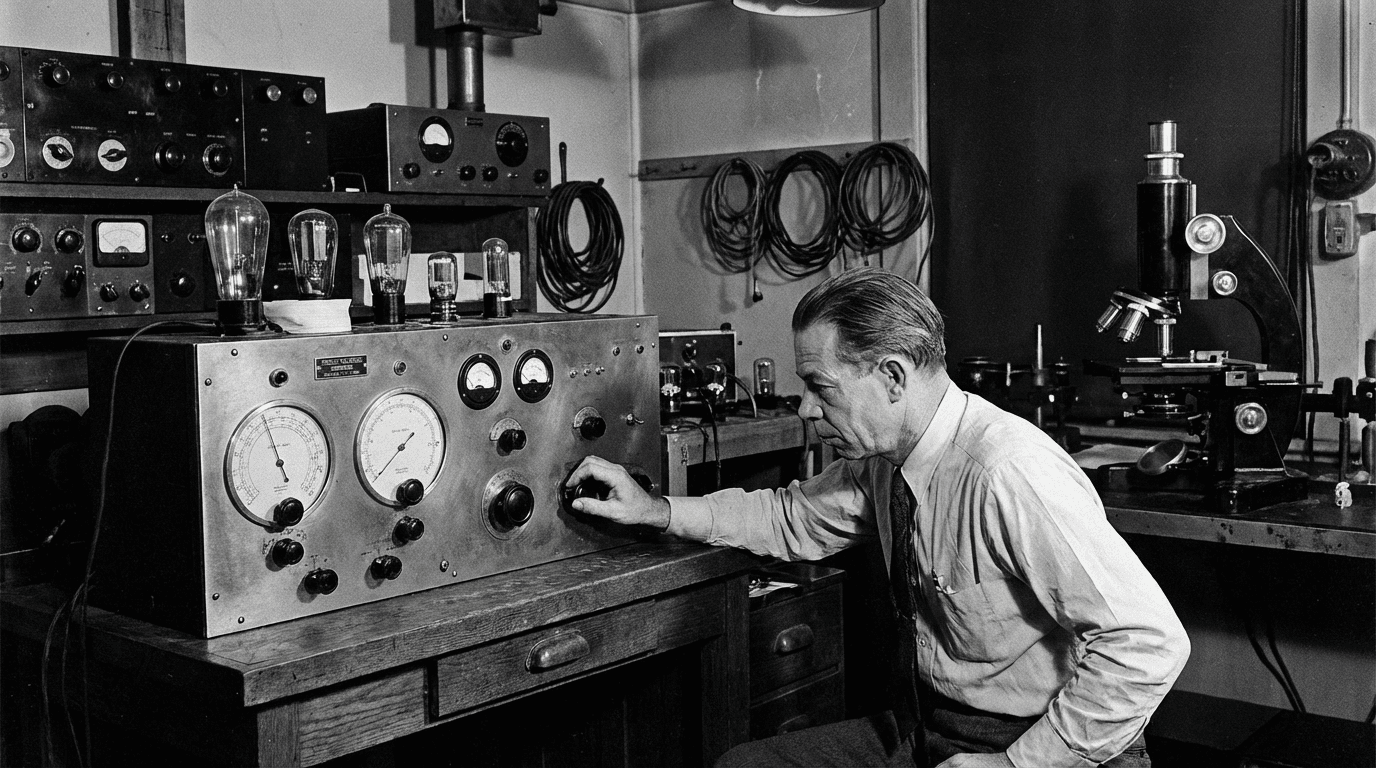 |
When you buy a "Rife machine" today, you're almost certainly NOT getting what Dr. Royal Raymond Rife actually used. Here's the rub: after a 10-year research project analyzing three original Rife machines built before 1950, researchers at RifeVideos.com discovered that most modern devices use frequencies Rife never employed—yet people report results anyway. The story of how this happened reveals both the suppression of Rife's true method and the unexpected efficacy of what replaced it.
Dr. Royal Raymond Rife (1888-1971) won 14 government awards for scientific discoveries and received an honorary medical degree from the University of Heidelberg for his work in bacteriology. His Universal Microscope achieved magnifications up to 60,000x using light optics—allowing him to observe living viruses in real-time, something electron microscopes still cannot do. From this work, he documented Mortal Oscillatory Rates (MORs)—specific frequencies that caused pathogenic microorganisms to structurally disintegrate through resonance.
According to analysis of original Rife machines by RifeVideos.com researchers, Dr. Rife's TRUE frequencies ranged from 139,200 Hz to 1,607,450 Hz—high radio frequencies (RF), not the low audio frequencies most devices use today. The 1934 clinic that achieved 16 recoveries from terminal cancer and tuberculosis patients used these high RF frequencies, generated through a method that has been largely lost to history.
Enter Philip Hoyland, Dr. Rife's engineer in the 1930s. Hoyland developed a brilliant but secretive solution to a patent problem: Dr. Rife couldn't patent his frequencies because the FCC has domain over all frequencies, and he couldn't patent his machines because frequency generation technology was already in the public domain. After all, Hoyland needed to protect the technology while allowing its use. His solution was the sideband method.
Hoyland's sideband method used various fixed RF carrier frequencies, likely to keep his system even more proprietary. One of these was a 3.30 MHz (3,300,000 Hz) fixed RF carrier frequency combined with specific low audio frequencies. When modulated together, these created harmonic sideband frequencies that matched Rife's high RF MORs. The genius was that neither component worked alone—the carrier by itself did nothing, and the audio frequencies by themselves did nothing. Only the combination produced the therapeutic high RF sidebands.
But Hoyland hid this method from everyone, including Dr. Rife. He never revealed how the Beam Ray Clinical machine actually worked. When the Beam Ray Corporation dissolved and Rife's business partners tried to replicate the machines in the 1950s, they faced a problem: they had the audio frequencies Hoyland used, but not the understanding of how they worked with the carrier.
John Crane, Dr. Rife's business partner in the 1950s and 1960s, built the AZ-58—a "replica" of the Beam Ray Clinical machine. He made a critical error: he used the low audio frequencies (like 727 Hz, 787 Hz, 880 Hz) WITHOUT the 3.30 MHz RF carrier, mistakenly believing these audio frequencies WERE Rife's original treatment frequencies. The AZ-58 did not work to its full capability, but the die was cast.
It's important to understand that at this time Royal Rife had already had his life's work stolen from him by Hoyland in the 1939 court battle. Having been ruined and losing his financial backing of his lab by Henry Timkin, he spent most of his days in Mexico City and most described him as a "working alcoholic". So clearly he wasn't at his peak intellect when Crane convinced him to resurrect the technology in the 1950s.
Modern "Rife machines" are descendants of Crane's AZ-58, not Rife's original Beam Ray machines. They use audio frequencies ranging from approximately 20 Hz to 20,000 Hz—frequencies Rife never used for treatment. According to RifeVideos.com's analysis of original machines, these devices cannot output Rife's true high RF frequencies (139K-1.6M Hz) because they lack both the RF output capability and the carrier frequency modulation system.
So why do people report results with these "wrong frequency" machines? Here's where the nuance matters. The distinction between Rife's method and Crane's method is about historical accuracy, not efficacy. Crane's audio frequencies likely work through different mechanisms than Rife's high RF sidebands—bioelectrical entrainment, cellular resonance at audio frequencies, nervous system modulation, and other biological effects that occur in the 20-10,000 Hz range.
The human body responds to frequencies across the spectrum. While Rife's high RF method may work through thermal and structural resonance at the cellular level, audio frequencies in the 727 Hz, 787 Hz, and 880 Hz range can influence bioelectric fields, neural signaling, and cellular communication through entirely different pathways. Both can produce therapeutic effects—they're just not the same method.
For those seeking Dr. Rife's original method, the requirements are specific: a device must output high RF frequencies up to at least 1,607,450 Hz, must include a 3.1-3.3 MHz carrier frequency capability, and must be able to modulate audio frequencies with that carrier to create sidebands. Few devices marketed as "Rife machines" meet these specifications. Most are frequency generators using Crane's AZ-58 audio frequencies—effective for some applications, but not Rife's original approach.
The lesson isn't that modern frequency devices are worthless—it's that they're different. When you use a device outputting 727 Hz, 787 Hz, or 880 Hz, you're using John Crane's 1950s audio-frequency method, not Dr. Rife's 1930s high RF method. Both have their place in frequency medicine, but conflating them obscures the historical record and prevents informed choice.
For HealthHarmonic's multi-frequency systems (sold exclusively as frequency generators for testing and research) and similar devices, the question isn't whether they work—many users report significant benefits—but understanding what you're actually using. If the device outputs primarily audio frequencies (20-10,000 Hz), you're working with Crane's paradigm. If it can generate high RF with carrier modulation, you may be approaching Rife's original method. Both represent valid approaches to frequency medicine, born from different eras and working through different mechanisms. Some even can do both!
The research-first approach demands we distinguish between what Rife discovered, what Hoyland engineered, what Crane replicated, and what modern manufacturers sell. Only with this clarity can practitioners and patients make informed decisions about frequency therapy. The frequencies may differ, but the goal remains the same: using resonance and bioelectric principles to support the body's natural healing capacities.
References
RifeVideos.com. "The Rife Machine Report: A History of Rife's Instruments and Frequencies" (January 2022, 313 pages). https://RifeVideos.com
RifeVideos.com. "Dr. Rife's True Original Frequencies." Analysis of three original Rife machines (Rife Ray #3, #4, #5/Beam Ray Clinical). https://rifevideos.com/dr_rifes_true_original_frequencies.html
Lynes, B. (1987). The Cancer Cure That Worked: 50 Years of Suppression. Marcus Books. https://www.whale.to/cancer/lynes_b.html
Clark, H.R. (1995). The Cure for All Diseases. Chula Vista: New Century Press. https://www.drclark.net/
Rife, R.R. (1953). The Rife microscope and frequency therapy. Journal of the Franklin Institute. https://rifeenergymedicine.com/
HealthHarmonic frequency protocols and device specifications. https://healthharmonic.com
|